
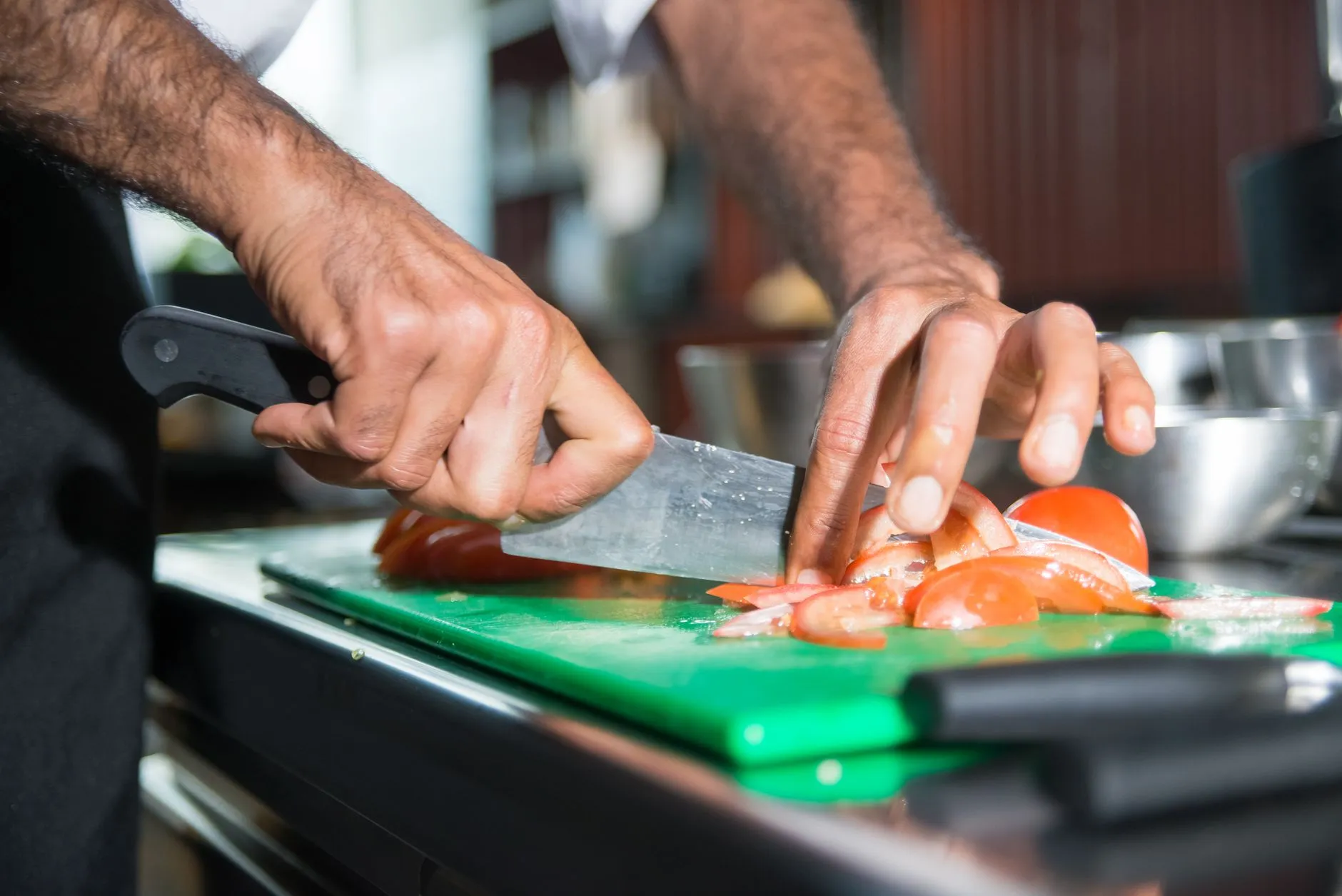
“How long should my knife stay sharp?” is one of the questions we hear most at the shop, and it’s also one of the hardest to answer with a single number. The honest answer is: it depends on a handful of variables you can mostly control.
How long should a knife hold its edge?
TL;DR: A well cared for kitchen knife used daily at home should hold a usable edge for two to six months before it needs a proper sharpening, not just a hone. The exact window depends on the steel, what you’re cutting, what you’re cutting on, and how you store and wash it. Get those right and you can push toward the long end. Get them wrong and a great knife can go dull in weeks.
Steel hardness sets the ceiling
The biggest variable is the knife itself. Steel hardness is measured on the Rockwell C scale (HRC), and it’s the clearest predictor of how long an edge survives normal use.
Most Western knives, Wüsthof and Zwilling among them, run around 56 to 58 HRC. Wüsthof’s Classic line is hardened to 58 on the Rockwell scale. That’s a deliberate choice, not a shortcoming. Softer steel flexes instead of chipping, which is why these knives feel forgiving on bone-in cuts and rough handling.
Premium Japanese knives, like Shun or Miyabi, are often hardened well past 60 HRC, sometimes into the mid-60s on knives using powdered steels like SG2 or VG-MAX. As one sharpening reference puts it, steel with a higher Rockwell rating holds an edge longer but has lower toughness, while softer steel resists damage better but won’t hold its edge as long. A harder edge resists the microscopic rolling that dulls a softer one, so it stays keen longer under the same use, but a 62 HRC gyuto is also less forgiving if it twists against a bone or hits a stone countertop. Match the knife to how carefully you handle it, not just to the spec sheet.
What you’re cutting matters more than people think
Edge retention isn’t just about the blade. It’s about what the blade meets, thousands of times a week. Cutting boneless chicken and herbs is gentle work. Cutting frozen food, winter squash with tough rind, or anything that touches bone puts real stress on the apex, and that stress adds up faster on thinner, harder edges than on thicker, softer ones.
The bevel angle matters too. Most kitchen knives sit in the 15 to 20 degree per side range, with Western knives historically closer to 20 degrees and Japanese knives often holding a thinner 15 degree edge. A thinner edge cuts more cleanly but has less metal behind it, so it’s more easily knocked out of true by hard contact. That’s part of why a Japanese knife can feel keener out of the box and still need attention sooner if it’s pushed into tasks it wasn’t built for.
Your cutting board is doing more work than you realize
The surface under the blade is one of the easiest variables to control, and one of the most overlooked. Every cut drives the edge into the board, and a board that’s too hard fights back. Glass, stone, and ceramic boards are the worst offenders. A well chosen wood or quality plastic board is gentler, since the surface gives slightly instead of grinding straight into the apex with every stroke.
If a knife feels less sharp within weeks of switching boards, the board is usually the first place to look, before assuming the knife or the last sharpening is to blame.
Storage and washing quietly shorten a knife’s life
A surprising amount of edge damage happens off the cutting board entirely. Loose knives rattling in a drawer dull each other with every bump. And the dishwasher is one of the fastest ways to undo a good sharpening: the water jets can knock a knife into whatever else is in there, damaging the edge, and detergent residue doesn’t help the steel either. Store knives in a block, on a magnetic strip, or with blade guards, and hand wash and dry them right after use. Neither habit costs real time, and both buy weeks of extra edge life.
So why does my knife still feel dull sooner than expected?
Usually it’s a combination, not a single cause. A softer Western knife on a glass board, washed in the dishwasher, will dull noticeably faster than the same knife hand washed and used on wood.
If you’re honing regularly and the knife still won’t bite into a tomato cleanly, the edge has likely worn past the point honing can fix. Honing realigns a rolled edge, it doesn’t remove metal or restore one that’s genuinely gone dull. At that point, it’s time for a real sharpening, not more steel work.
The bottom line
There’s no fixed answer to how long a knife should hold its edge, but the variables are well understood: harder steel holds longer but tolerates less abuse, what and how you cut matters as much as the blade, and your cutting board, storage, and washing habits can add or subtract weeks without you touching a stone. Control what you can, and you’ll find yourself reaching for the sharpening kit on your schedule, not the knife’s.
When it is time, that’s what we’re here for, same day, hand guided, water cooled. No heat damage, no surprises.